
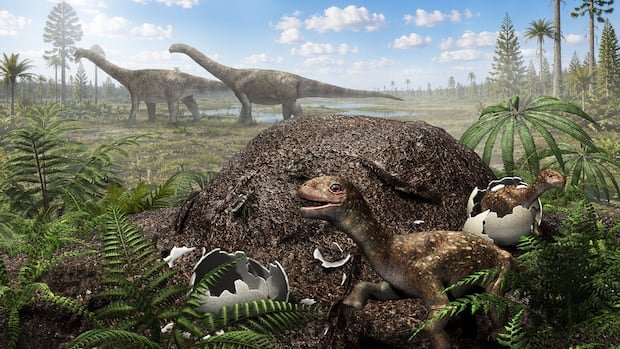

Fossil eggshells from some of the largest dinosaurs ever discovered have been unearthed in a surprisingly cool climate, far from the equator. Even though these colossal titanosaurs couldn’t warm their volleyball-sized eggs by sitting on them, a recent study sheds light on how they managed to keep the eggs at the right temperature for hatching.
According to University of Calgary paleontologist Darla Zelenitsky, the titanosaurs likely used a unique incubation technique to ensure the eggs stayed warm. By analyzing the microscopic pores on the eggshells, researchers found similarities with the incubation method used by modern crocodiles, who bury their eggs in warm piles of decomposing vegetation.
Titanosaurs, massive plant-eating dinosaurs with long necks and tails, roamed the Earth on four legs, weighing up to 75 tonnes – about half the mass of a blue whale. The discovery of volleyball-sized fossil eggs linked to titanosaurs in the Chorrillo Formation in southern Argentina provides insights into the reproductive behavior of these ancient giants.
The Chorrillo Formation, dating back to the Late Cretaceous period, housed a diverse ecosystem where titanosaurs like Nullotitan glaciaris coexisted with smaller herbivores, predators, and various other creatures. The finding of titanosaurs’ eggs in such a distant location from the equator suggests their adaptability and resourcefulness in overcoming environmental challenges for survival and reproduction.
The study highlights the remarkable nesting strategies of dinosaurs, showcasing how even the largest species managed to thrive in different environments. This discovery opens up new avenues for further research on titanosaurs’ nesting behaviors and their evolutionary success during the Late Cretaceous period.