
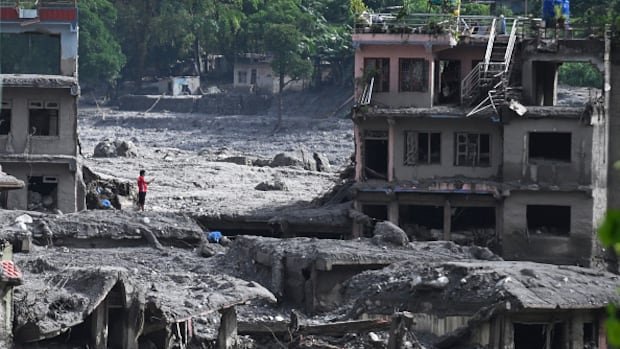

Rescue teams equipped with search dogs are still combing through mud, rocks, and debris along the Nepal-China border in search of thousands of missing individuals in the aftermath of devastating floods that ravaged Himalayan communities, resulting in over 1,000 confirmed deaths.
In Kathmandu, as police laid to rest multiple bodies in graves, Nepal’s disaster agency reported a death toll of 1,003 in the country, with 3,916 people missing, including 583 foreign nationals. China, in its most recent update, confirmed 16 fatalities and 546 missing persons, including 261 foreigners.
The extensive impact of the disaster on August 26 has complicated rescue operations in both nations due to landslides, damaged infrastructure, and widespread destruction isolating remote areas. Rescue teams are facing challenging conditions navigating unstable terrain and debris piles, heightening concerns that the death toll might escalate as rescuers reach secluded communities.
Efforts are underway to reach hundreds of workers thought to be trapped within tunnels at hydropower projects in Nepal that sustained flood damage. Approximately 900 workers are unaccounted for across 12 projects, with an estimated 500 believed to be stuck in tunnels, as stated by local authorities.
Nepal’s army spokesperson, Brig. Gen. Raja Ram Basnet, disclosed that teams, aided by foreign experts, are engaged in rescue operations at various hydropower facilities. Images released by the army depict rescue teams entering debris-filled tunnels and navigating muddy water in search of survivors.
On the Chinese side, rescue teams are scouring areas affected by mudslides, particularly around the Gyirong Port border crossing, which suffered severe damage.
Some rescue squads, supported by search dogs, are meticulously searching through gaps amid rocks and debris for any signs of life. Concurrently, other teams are utilizing heavy machinery to clear a critical highway leading to Gyirong Port in hopes of facilitating the passage of equipment, personnel, and supplies to the disaster zone, according to China’s state-operated Global Times newspaper.
In Kathmandu, authorities are working diligently in adverse weather conditions to inter multiple bodies in trenches adjacent to a wooded area. The site has been secured with barbed wire fencing, and the graves are marked with numbered identifiers for unidentified individuals.
Relief operations have been expanded to reach stranded communities, with over 11,814 individuals rescued thus far by Nepalese authorities. Helicopters and aircraft have been deployed to access isolated areas where transportation infrastructure has been destroyed by floods and landslides.
To support survivors in areas cut off by damaged routes, the federal government is dispatching $5 million in emergency aid to Nepal, with additional assistance planned for reconstruction efforts, announced Foreign Affairs Minister Anita Anand via social media.
Foreign Ministry spokesperson Guo Jiakun of China revealed that a second batch of relief supplies, including drones, DNA testing kits, and water purification equipment, is being dispatched to Nepal. Chinese DNA testing experts will also aid in the identification of bodies.
The catastrophe originated in the Himalayas from a glacial collapse, triggering torrents of water, rocks, and debris downstream. Scientists analyzing satellite data indicated that the collapse resulted from the failure of bedrock beneath a glacier in the Himalayan region, registering as a seismic event of magnitude 5.2.
Nepal’s Prime Minister Balendra Shah emphasized the urgency to address climate change in light of the disaster’s repercussions, underscoring the escalating risks faced in the Himalayan region due to climate change.
Filmmaker and drone pilot Manish Maharjan, who traversed into Nepal from Tibet prior to the calamity, found himself utilizing his expertise in rescue operations following the disaster. Deploying drones, Maharjan assisted in locating individuals stranded in precarious locations, employing innovative methods to reach and rescue them.
While drones proved effective in open areas, navigating flooded tunnels presented distinct challenges, requiring unique strategies for successful rescue operations.