
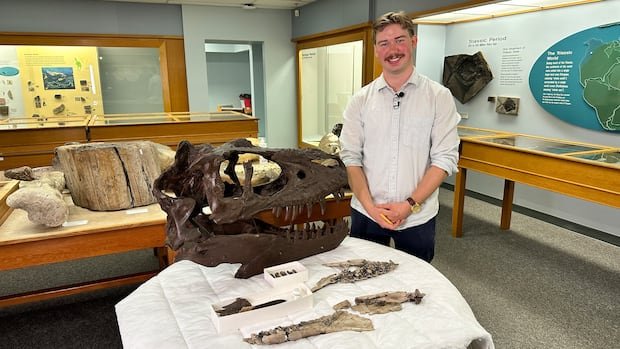

A groundbreaking finding by University of Alberta researchers suggests that a raptor dinosaur might have preyed on a larger tyrannosaur, based on bite marks discovered on the jaw of an Albertosaurus, a relative of the renowned Tyrannosaurus rex. The incident is believed to have occurred around 70 million years ago in Alberta.
The fossil belonged to an eight-year-old Albertosaurus that had not yet reached full maturity. The presence of bite marks sparked two divergent theories regarding the fate of the dinosaur post-mortem near Drumheller, Alta., approximately 130 kilometers northeast of Calgary.
Researchers propose that a raptor, a smaller carnivorous dinosaur, likely scavenged on the deceased Albertosaurus. This rare event sheds light on carnivorous dinosaur behavior, offering insights into the prehistoric food chain complexity.
Philip Currie, a University of Alberta professor specializing in dinosaur paleobiology, described the finding as significant, emphasizing that the Albertosaurus was a dominant predator of its era.
The discovery could revolutionize the understanding of dinosaur interactions and the dynamics of ancient ecosystems. Joshua Doyon, a paleontology master’s student at U of A, led the investigation into the bite marks, concluding that a raptor was the probable culprit based on tooth mark analysis.
An alternate hypothesis suggests that the Albertosaurus may have been cannibalized by a much younger member of its own species, measuring around two meters in length and less than two years old.
Uncovering the Fossil
The fossil, unearthed in 2022 by a local explorer in the badlands north of Drumheller, was reported to the Royal Tyrrell Museum. The museum’s subsequent examination revealed the tooth marks, leading to Doyon’s research project in 2023.
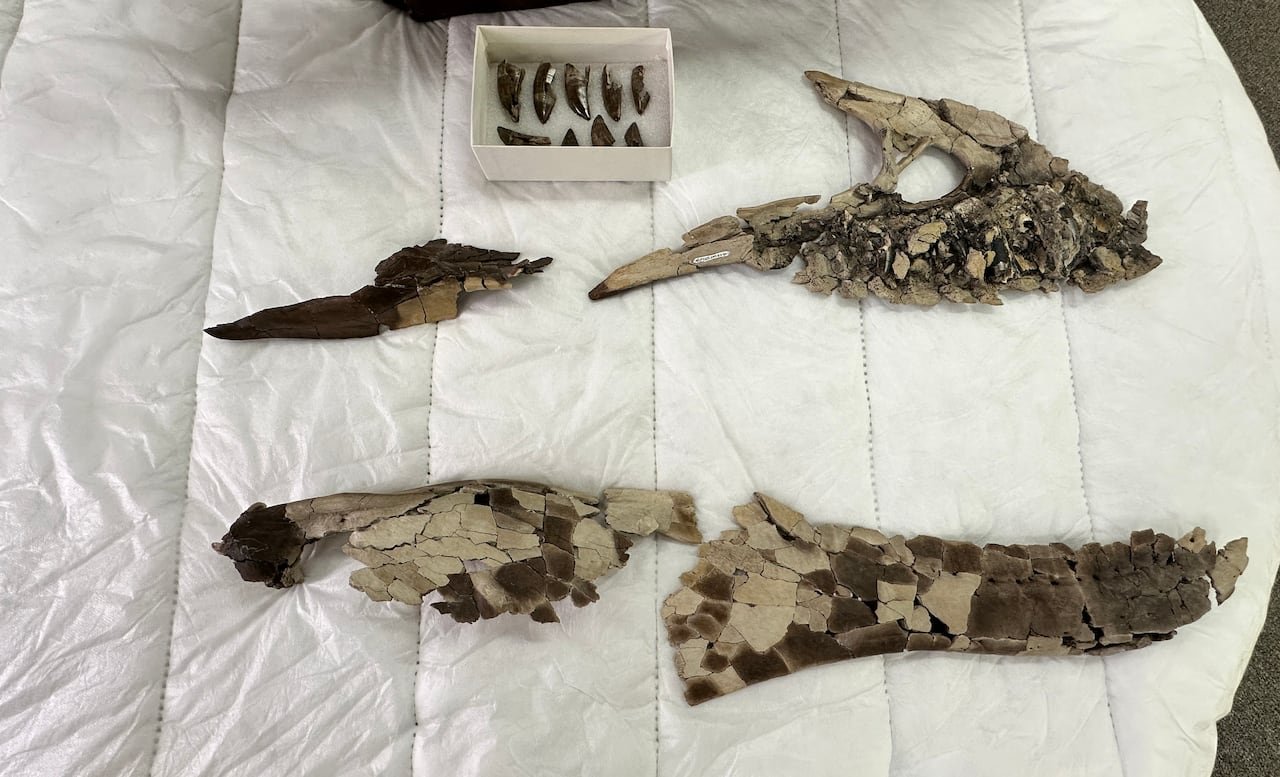
A closer view of the fossils that Doyan used in his research. (Scott Neufeld/CBC)
Doyon’s interest in studying dinosaur behavior and species interactions led him to investigate this ancient feeding event. Currie emphasized the importance of examining fossils for behavioral insights rather than solely focusing on animal identification.
Details like the tooth marks can provide valuable information on predator-prey relationships and ecosystem dynamics in prehistoric times.
The Albertosaurus, an apex predator, likely fell victim to a smaller raptor, comparable in size to a German shepherd. This discovery stands out as rare evidence of carnivorous dinosaurs preying on each other, rather than herbivorous creatures.
Contrary to popular depictions in movies like Jurassic Park, the raptors in Alberta were smaller than portrayed, belonging to a group known as dromaeosaurs. The local species, Atrociraptor, measured about two meters in length.
Doyon hopes that future paleontologists and fossil finders will pay attention to subtle tooth marks that could reveal intriguing insights overlooked in the past.
Tag: rewrite-pending