
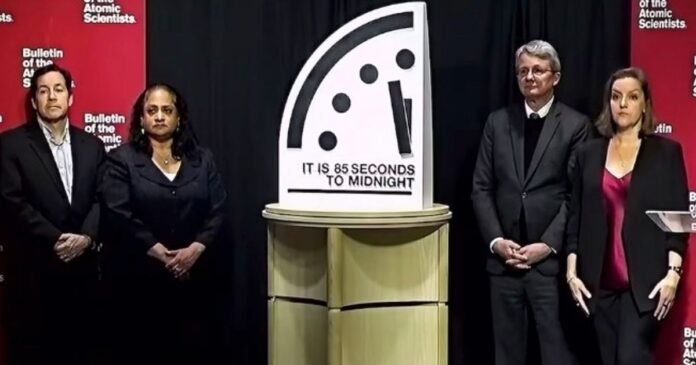

The Doomsday Clock, an annual gauge of humanity’s proximity to global catastrophe, has moved forward by four seconds to just 85 seconds before midnight – the closest it has ever been. The Bulletin of the Atomic Scientists, the organization behind the Clock, introduced it in 1947 to evaluate the risks of extinction from various sources. Midnight on the Clock symbolizes the failure of humanity to prevent complete devastation.
The adjustment to the Doomsday Clock was announced at 3 pm on Tuesday (January 27) from Washington DC, US. Alexandra Bell, the CEO of the Bulletin, expressed disappointment in humanity’s inability to preserve Earth’s habitability, emphasizing the urgency of the situation.
“We are rapidly running out of time,” she stressed. “This harsh reality has painted a grim picture for addressing existential risks in 2025.”
Board member John Wolfsthal highlighted that setting the Clock’s position usually involves challenges, but this year presented no such obstacles. The Clock has been steadily approaching midnight, moving from 90 seconds to midnight in 2023 to 89 seconds to midnight the following year.
This stands in stark contrast to 1991 when the Clock was furthest from midnight at 17 minutes following nuclear disarmament agreements between the US and the Soviet Union. While some individuals are alarmed by this trend, critics dismiss the Clock as a fear-inducing tactic aimed at the public.
In online discussions, skepticism about the Clock’s significance was apparent. Some users criticized its lack of measurability and perceived randomness in its initial positioning. Others suggested the need for multiple clocks to gauge various societal threats effectively.
Despite the skepticism, defenders of the Clock pointed out that it is based on scientific analysis of global trends and changes. They emphasized the importance of listening to experts and not dismissing warnings until it is too late.
In conclusion, the Doomsday Clock’s movement reflects growing concerns about existential risks and the urgent need for global action to address them.