
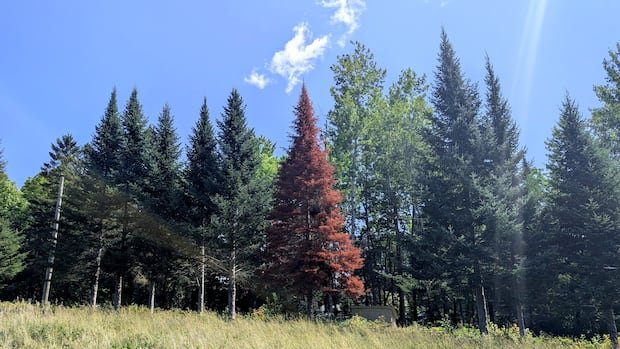

Balsam fir trees in New Brunswick are exhibiting a concerning trend of turning red and perishing following last year’s unprecedented drought, raising apprehensions about the fate of the regional tree. Forestry researcher Prof. Anthony Taylor from the University of New Brunswick has been receiving reports from woodlot owners and witnessing the devastation firsthand. The vibrant evergreen trees, popularly chosen for Christmas decorations, are gradually transitioning to a red, desiccated state before succumbing.
As per Prof. Taylor’s observations, this pattern aligns with the aftermath of past hot and arid summers. The impact of warm, dry conditions like the recent drought is detrimental to the growth capacity of balsam fir. Taylor, who has been studying the influence of climate change on New Brunswick’s forests extensively, notes that similar instances of balsam fir die-offs ensued following exceptionally hot, dry periods in 1986 and 2018.
The research reveals that trees halt the photosynthesis process prematurely in response to drought stress, impeding their growth. This disruption results in an inadequate production of energy reserves crucial for sustaining basic metabolic functions and generating defense compounds. Consequently, the trees become more vulnerable, amplifying the risk of die-off, especially if they are already under stress from insects or pathogens.
The shallow root system of balsam firs complicates their ability to access water during dry spells. Peter McKeil, a woodlot owner, detected initial signs of damage to the balsam firs on his property in June, observing a gradual reddening of the lower branches upwards. The ongoing die-off, marked by the emergence of new red patches daily, has led to the loss of approximately 100 trees for McKeil. Despite salvaging some of the deceased trees for lumber, he is revising his harvesting strategies to maximize the remaining fir before further losses occur.
McKeil expresses a grim outlook on the future of the species, particularly in southern New Brunswick, attributing their decline to the worsening climate conditions. He anticipates that the trees may need to adapt or migrate northward to survive in the changing environment. The visible impact on balsam firs this year serves as a tangible illustration of the adverse effects of climate change on the provincial tree, underscoring the urgency for climate action.
Prof. Taylor views the red trees as a dual-edged symbol – aiding his research while symbolizing the detrimental consequences of climate change on New Brunswick’s iconic tree. He likens the situation to a canary in a coal mine, a clear indicator of the climate crisis. Taylor’s aspiration is that his findings will resonate with stakeholders and catalyze meaningful change, emphasizing the imperative to reduce reliance on fossil fuels and adopt sustainable forest management practices to address climate change promptly.