
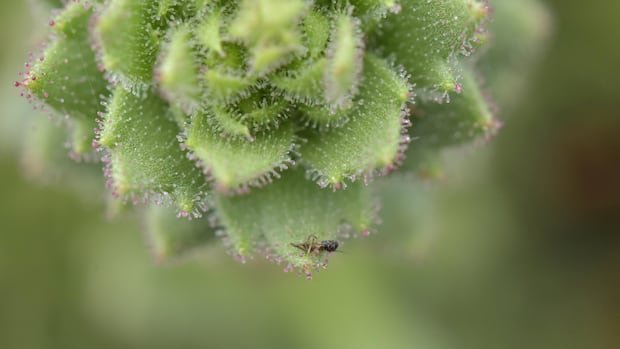

Botanist Douglas Soltis recently shared insights in an interview about a groundbreaking discovery related to a seemingly harmless flowering plant turning out to be carnivorous. The plant in question, Saxifraga candelabrum, found in the rocky mountain crevices of southwestern China, employs sticky hairs to trap and consume unsuspecting insects, as revealed in a new study published in Nature Communications.
These findings confirm a theory proposed by Charles Darwin over a century ago regarding predatory behavior within the Saxifraga genus. Darwin, a renowned naturalist recognized for his evolutionary biology contributions, initially noted insects stuck to leaves and stems of European Saxifraga varieties in 1875 but lacked definitive proof of their carnivorous nature.
To validate the plant’s predatory tendencies, researchers conducted experiments using fruit flies enriched with nitrogen, a vital nutrient sought after by the nutrient-deprived mountain plants. This study sheds light on the evolutionary advantage of carnivory in nutrient-poor environments, where plants like Saxifraga candelabrum developed mechanisms to extract nutrients from trapped insects while preserving pollinators unharmed.
The research suggests that more carnivorous plants may exist undiscovered, potentially within Darwin’s favored Saxifraga genus. Notably, a plant in British Columbia’s Cypress Provincial Park was previously found to employ similar trapping and feeding methods as Saxifraga candelabrum, indicating a broader presence of plant carnivory in nature. According to the UK’s Natural History museum, there are over 630 known carnivorous plant species worldwide, showcasing diverse mechanisms for capturing prey, ranging from Venus flytraps to pitcher plants that lure and digest insects with enticing fluids.
Soltis emphasized the remarkable adaptations of plants in acquiring essential nutrients, highlighting the intriguing dynamics of plants engaging in carnivorous behavior to sustain themselves. The intricate ways in which plants interact with their environment, such as trapping insects for vital nutrients, underscore the fascinating role of plants as predators in the natural world.