
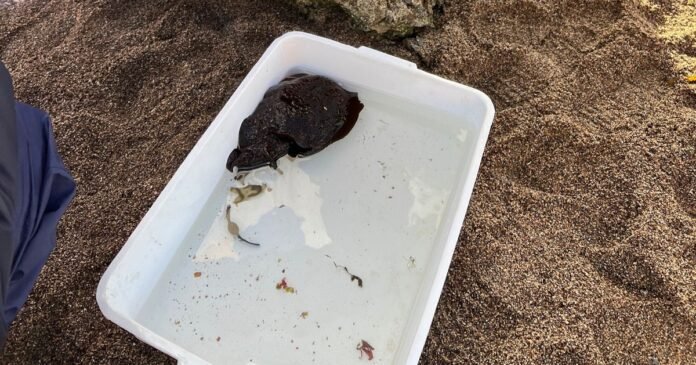

A young rock-pool enthusiast made an extraordinary discovery when he stumbled upon a rare “alien-like” winged creature washed ashore on a beach in the UK.
Charley Taviner, a five-year-old, was trailing a crab when he came across what initially seemed like a large mass of seaweed. To his surprise, it turned out to be an Aplysia depilans, known as the “Mediterranean sea hare,” a species seldom seen in the UK.
The sea hare, known for secreting toxins, is typically native to the Mediterranean and East Atlantic regions. The Marine Biological Association attributes the appearance of the sea hare on UK beaches to warmer waters and increased storms. Charley found the sea hare on Mount Batten Beach in Plymouth, Devon, during The Rock Pool Project’s monthly “BioBlitz Battle” organized by the Marine Biological Association.
Joe Feasey-Kemp, an Aquarium and Research Facilities Technician at the Marine Biological Association, cautioned that the animal secretes toxins, advising caution to dog walkers who may encounter it. The MBA highlighted that the warming waters and intensified storms likely facilitated the sea hare’s presence on UK shores.
A representative for the MBA suggested that the species may have acclimated to UK shores due to warming waters and increased storms. Aplysia depilans, a type of mollusc, can reach lengths of up to 40cm, weigh as much as 380g, and are notably larger than the more common Spotted sea hare.
The MBA explained that these molluscs swim by fluttering their two large “wing-like flaps of tissue” called parapodia, making them surprisingly agile. Since its launch in October 2024, The Big Rock Pool Challenge has identified and documented over 255 different species at Mount Batten.
Loretta Kwok, the South West Lead of the challenge, emphasized the significance of these discoveries in showcasing the richness and dynamism of coastal ecosystems. She highlighted the ongoing potential for exploration and the diversity present in local rock pools and coastal habitats.