

According to Canada’s former representative to the European Union, it is crucial for Canada to strengthen its ties with Europe, irrespective of the ongoing trade conflict with the U.S.
During a recent address in France, European Commission President Ursula von der Leyen heaped praise on Prime Minister Mark Carney and indicated that Europe is interested in paving the way for Canada to potentially become an “associate member” of the EU.
The specific implications of this concept remain ambiguous, as there is currently no such legal status within the EU framework.
Jonathan Wilkinson, the newly appointed ambassador from Canada to the EU, stated that both parties are still “a ways away” from agreeing on a description for a potential partnership, let alone a formal title.
In contrast, Conservative Leader Pierre Poilievre has expressed that any form of EU membership could burden Canadians with “higher taxes to a government in Europe or compliance with regulations set by European officials.”
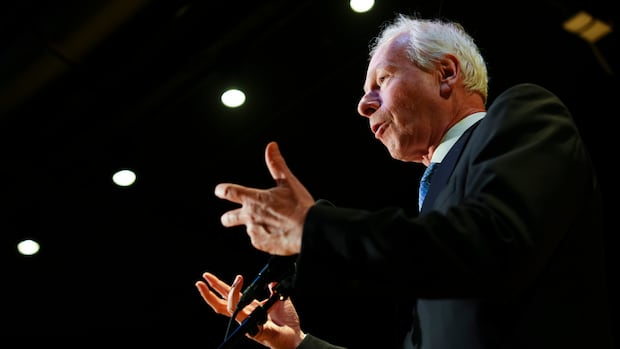
However, former Liberal leader Stéphane Dion, who served as the special envoy to the EU from 2017 to 2025, argues that such a scenario is unlikely. Below is an excerpt from his discussion with As It Happens host Nil Köksal.
It seems there was a notably positive response for Canada and Prime Minister Carney today. What does the term “associate member” suggest to you? Are you pleased to hear that phrase?
I believe President von der Leyen aimed to convey her ambition for the Canada-EU relationship. She also intended to inspire EU member states to share the same level of ambition.
However, the prime minister’s intention is to avoid creating the impression that Canada might relinquish some of its sovereignty to Brussels or that any federal or provincial matters would be managed from there.
I think during his address to the European Parliament tomorrow, the prime minister will clarify his desire for a robust partnership that allows for trade development, military collaboration, contracts, and scientific cooperation, all while maintaining the status of two sovereign nations.

European Commission President Ursula von der Leyen has proposed opening a path for Canada to become the European Union’s first associate member, a status that doesn’t currently exist.
Do you think Canadian officials were caught off guard by von der Leyen’s language, or were they anticipating this and ready to respond diplomatically?
I suspect there may be some surprise, including among the leaders of the EU member states.
Nonetheless, the main issue for all of us is not the label we assign it, but the necessity of fostering a stronger bond between Canada and the EU moving forward.
The pivotal moment will arrive on October 29th and 30th in Canada, when the EU and Canada convene for their next summit. I anticipate the prime minister will announce the summit’s location tomorrow. During this summit, we need to evaluate the progress of our relationship and consider the potential for future advancements.
When you held your previous position, did you envision this level of closeness or that we would be discussing these matters at this time?
Indeed, we consistently worked towards enhancing our relationship with the EU. The terminology we used to describe it was not a concern back then. It has become a topic of discussion now. However, the terminology is secondary to tangible outcomes.
For instance, we have long emphasized the need for collaboration on critical minerals. Now, we should see significant investments from Germany, France, Italy, and Poland in Canada to advance mining operations and supply resources to the market, including the EU market.

Jonathan Wilkinson, Canada’s incoming ambassador to the European Union, says ‘we’re not there’ after European Commission President Ursula von der Leyen offered to open the door to associate membership. ‘What we’re focused on is actually driving results,’ he said, adding the government will ‘eventually’ turn to how to describe the relationship.
Conservative Leader Pierre Poilievre is raising concerns about issues that you seem to believe are not currently on the agenda. Should questions surrounding sovereignty be a concern for Canadians at this point?
Yes, but the notion that Canada might join the EU has not even reached the preliminary stage. We have never agreed to the loss of sovereignty that such membership would entail. The EU would face significant challenges in accepting us as a member due to apprehensions regarding competition, particularly in agriculture. Thus, it wouldn’t be feasible.
What is feasible, however, is cultivating stronger partnerships across all the areas the prime minister will address in his upcoming speech—scientific collaboration, trade, investments, military cooperation, and Arctic initiatives.
They said “no” in a referendum in Iceland … just to continue discussions about potentially joining the EU due to concerns about sovereignty and particularly fishing. So, it’s not only Pierre Poilievre who is raising these issues. How does the example of Iceland relate to Canadian concerns?
In Iceland, there was even a question posed about whether to join the EU. In Canada, however, this conversation is not mainstream, although some corners may discuss it. Thus, I believe there’s no significant partisan disagreement on this matter.
We seek a stronger bond with the EU, but we also intend to preserve our identity as Canada. This goal is essential for the long term. Not just because of challenges posed by Trump for Canada and the EU, which is a reason for desiring closer relations, but certainly not the only one.
The primary motivation is Canada’s uniqueness. We are a solid ally of the EU and arguably the most European of non-European nations. We possess the mineral resources that the EU requires. We need investments, and we share common views on global matters, including the Middle East, Ukraine, and NATO. We keep our commitments and are seen as a reliable partner for all these reasons.
Canada is not just any country; it is the key nation that the EU is eager to collaborate with, as highlighted by Madame von der Leyen today.

Prime Minister Mark Carney has said Canada is ‘not looking to be a member of the European Union.’ But if we did want to join the EU, is that even possible? Here are the facts.
As previously mentioned, the acceleration of this dialogue may be attributed to the current situation with the United States. The Carney administration has indeed discussed exploring new markets and establishing partnerships. Ultimately, how much relief could a stronger alliance with Europe provide?
The EU faces similar challenges with Trump as we do, making Canada appear as the favorable country in North America. This certainly encourages closer ties. However, I emphasize that this should not be the sole reason for our relationship.
In two years, we may hope for a more reasonable and amicable U.S. president. Even then, it will remain our objective not to put all our reliance on a single partner.
Europe cannot supplant the U.S. in our relations. The U.S. will continue to be our primary ally. However, a stronger relationship with Europe can lessen our dependence on the U.S. and enhance our strategy for diversification.