


During a bilateral meeting held in Shenzhen, China, on Tuesday, Prime Minister Mark Carney and Chinese President Xi Jinping reached an agreement to enhance economic and trade relations. This agreement expands a tariff arrangement to provide relief on Canadian exports estimated at about $400 million, covering various pork and seafood items.
-
Canada and China unveil new trade initiatives and cultural collaborations on Carney’s first day in Shenzhen
-
Audio
Carney discusses deeper automotive connections with China. What are the implications?
In exchange, Canada consented to reduce certain tariffs on steel and aluminum.
Here’s an overview of the implications for various sectors.
Seafood
In January, Carney and Xi had previously established a deal that led to China abolishing tariffs scheduled to start in March 2025 on several agricultural and seafood items, including a 25% tariff on lobster and crab.
On November 4, the federal government revealed that China would prolong the tariff-free status for an additional two years.
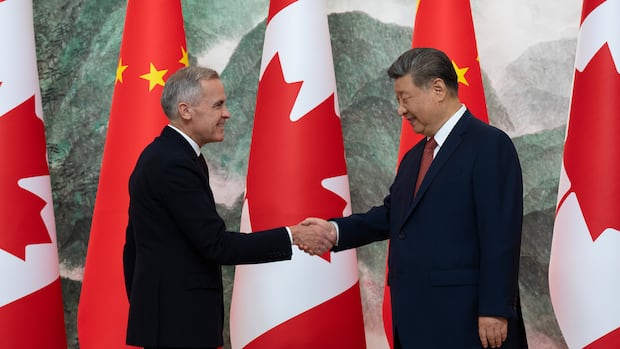
Prime Minister Mark Carney and Chinese President Xi Jinping have finalized a trade agreement that will result in China lowering tariffs on approximately $400 million worth of Canadian exports, including frozen pork and shrimp, until 2028. In exchange, Canada will continue granting tariff exemptions for specific Chinese steel and aluminum products.
In the announcement made on Tuesday, the tariff elimination was broadened to encompass “certain frozen cold-water shrimp and prawns, including Pacific spot prawn ($87.5 million); certain molluscs, such as geoduck ($61.4 million); sea cucumber ($39.4 million); and Greenland halibut ($96 million).”
By 2024, around 16% of Canada’s fish and seafood exports were directed to China.
Canola Meal, Peas, and Other Crops
Like lobster and crab, canola meal and peas also benefited from the same relief and extension earlier this month, which meant the elimination of 100% tariffs.
Tuesday’s agreement further allows for Canadian fava beans, chickpeas, and lentils to access the Chinese market.
Bill Prybylski, president of the Agricultural Producers Association of Saskatchewan, remarked earlier this month that the federal government’s announcement is fantastic news for canola farmers.
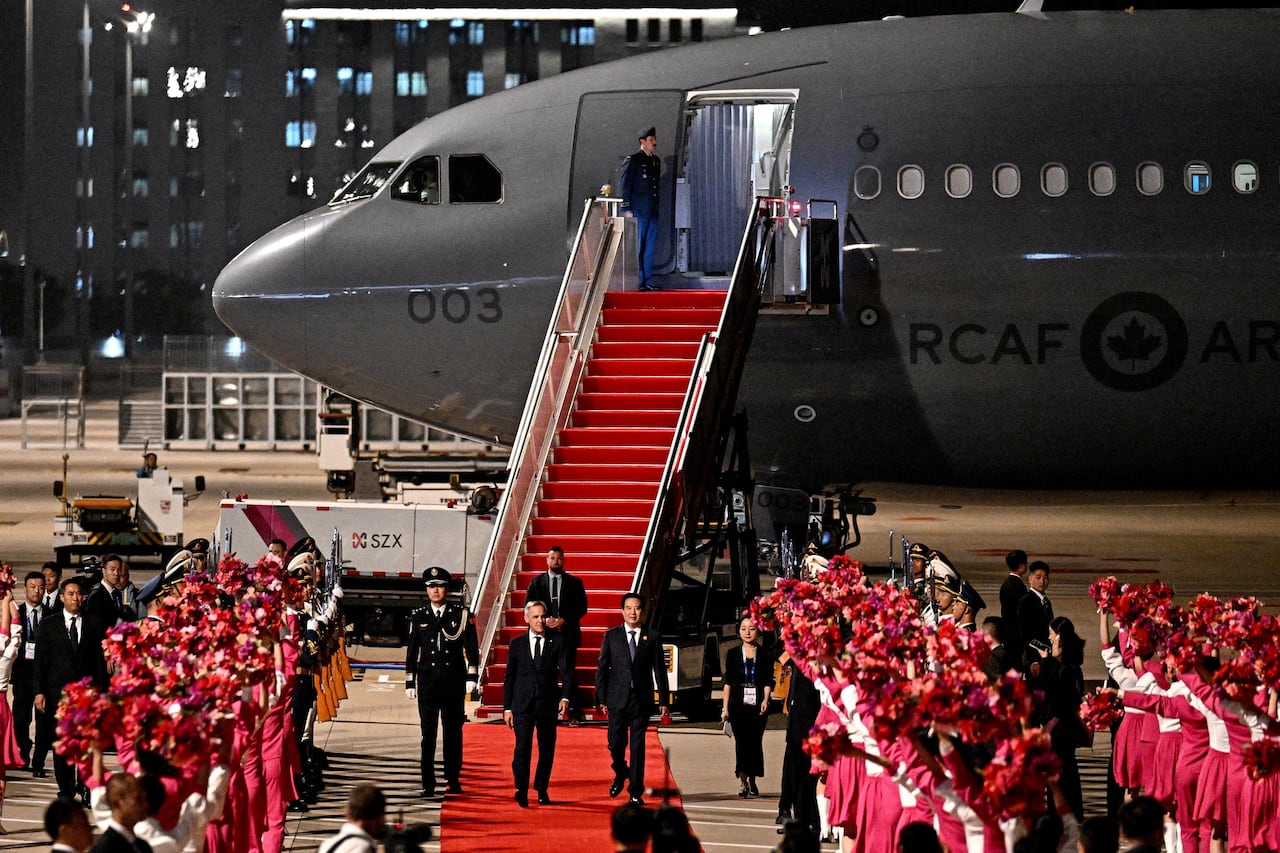
Carney arrives at Shenzhen Bao’an International Airport ahead of the Asia-Pacific Economic Cooperation (APEC) summit on Monday. (Pedro Pardo/Reuters)
“[It] provides our producers with some assurance to proceed with their plans, knowing that there will be a market for canola meal.”
The tariffs on canola seeds were reduced from 84% to 14.9% in March and have remained at that lower rate following the extension on November 4.
It is worth noting that canola oil is not included in either agreement and still faces a 100% tariff.
Prybylski has expressed concerns regarding the canola oil tariff, though he believes it is less critical compared to the ability to sell canola meal and seeds in China.
“We would prefer the tariff to be eliminated, but it is manageable for now,” he stated.
Pork
Pork was not part of the January agreement, but now “most frozen pork cuts,” valued at $116 million, will have their tariffs waived until at least December 31, 2028, which is the new expiry date for all tariff agreements.
The pork industry welcomed the new agreement as a significant advancement in regaining some of the market access lost over years of diplomatic tensions.
In 2024, prior to the tariffs, Canada exported $468.6 million worth of pork products to China.
The Canadian Meat Advocacy Office based in Beijing commended the increased access for pork but highlighted that offal remains restricted. Offal refers to the internal, non-muscular parts of animals, such as organs and entrails.
Kyle Larkin, CEO of the Canadian Meat Council, remarked that the Chinese market is highly lucrative, partly due to the variety of meat cuts consumed there.
“China has a vast consumer market that enjoys items like feet, heads, different offal, kidneys, hearts, etc., which are not as popular among Canadian consumers,” he explained.
Steel and Aluminum
In response to the mentioned tariff relief, Canada has agreed to extend until December 31, 2028, the tariff relief known as remission on certain Chinese steel and aluminum products that were set to expire at the end of this year.
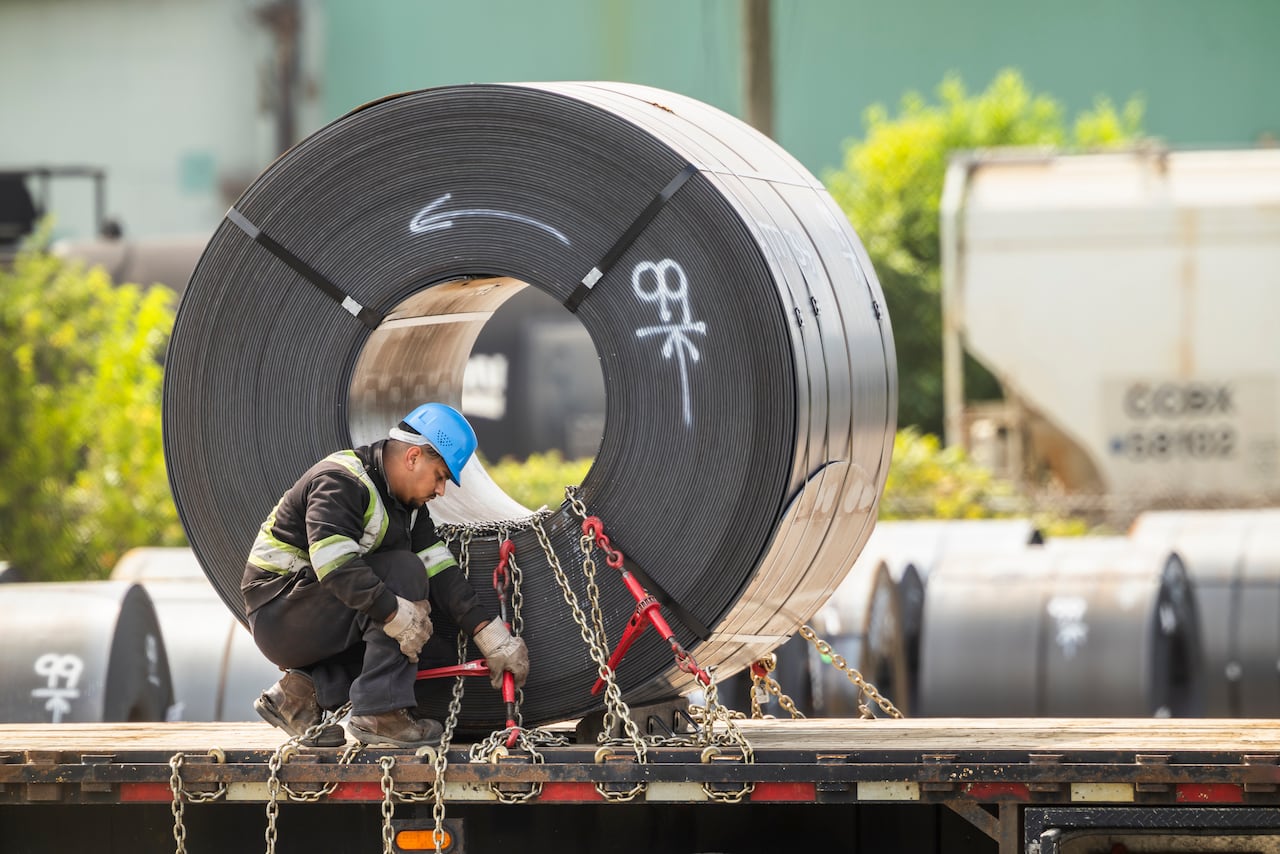
A worker secures a rolled coil of steel on a flatbed in the ArcelorMittal Dofasco steel plant in Hamilton, Ontario, on August 20. (Nick Iwanyshyn/The Canadian Press)
The agreement on Tuesday added 32 new items to the remission list — comprising 23 steel tariff items and 9 aluminum tariff items, for products deemed “insufficient or unavailable” by the Canadian government.
CBC News has contacted the Canadian Steel Producers Association and the Aluminum Association of Canada for comment.
Electric Vehicles
In the January agreement, Carney permitted the entry of tens of thousands of Chinese electric vehicles into Canada with reduced tariffs.
Canada lowered its 100% tariff on Chinese electric vehicles to 6.1%, initially allowing for up to 49,000 vehicles each year, with the cap set to rise to 70,000 vehicles over a five-year period. Since then, Chinese manufacturers BYD, Geely, and Chery have begun efforts to enter the Canadian market.
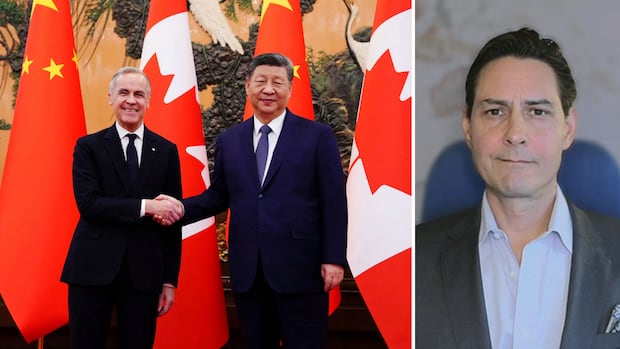
The trade relationship between Canada and China, while crucial, requires careful management, according to Michael Kovrig, a former diplomat who was detained in China on espionage allegations for over 1,000 days. He asserts that the benefits in Prime Minister Mark Carney’s recent trade agreement disproportionately favor China over Canada.
There were no significant updates regarding electric vehicles announced on Tuesday; however, a background document issued on November 16 indicated that the agreement has led to the import of 16,211 electric vehicles into Canada since March, with around half priced under $35,000 CAD.
Starting next year, 10% of the quota assigned for affordable electric vehicles priced at $35,000 CAD or lower will be allocated, increasing to 50% by 2030.
“Canada anticipates that this arrangement will trigger significant new investment from Chinese joint ventures in Canada with reliable partners to safeguard and create new auto manufacturing jobs for Canadian workers while ensuring a strong development of Canada’s electric vehicle supply chain,” the document states.