
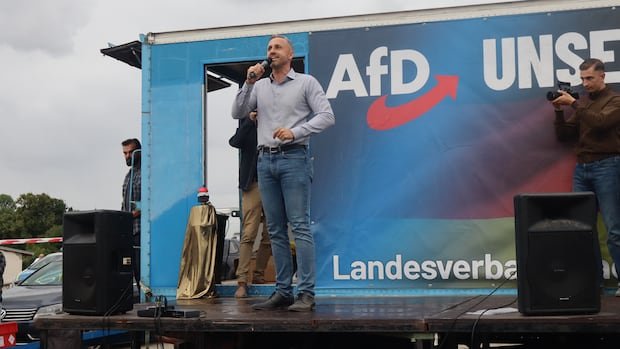

In the serene town of Quedlinburg in eastern Germany, a large crowd gathered on a sunny August afternoon to listen to a prominent far-right leader’s vision for the nation’s future. The leader, Ulrich Siegmund, who is the Alternative for Germany (AfD) party’s candidate for the eastern state of Saxony-Anhalt, attracted many supporters, including those arriving on Simson motorcycles, which have become a symbolic representation for the party.
With the AfD gaining momentum in opinion polls, there is a possibility that it could make history by becoming the first far-right party to hold state power in Germany since World War II. The party’s ambitions include influencing state resources in various sectors, particularly education. Their objectives range from implementing segregated classrooms for refugees to fostering ties with Russia through student exchange programs and advocating for a patriotism-driven agenda that shifts focus away from the country’s Nazi history.
As supporters gathered to hear Siegmund speak, expressing admiration and loyalty, counter-protesters on the opposite side of the street raised rainbow flags and sang songs in a display of unity against what they perceive as a threat to fundamental human rights and the democratic order established in postwar Germany.
The AfD’s rise in Saxony-Anhalt, where they lead in opinion polls, raises concerns among experts and citizens alike. The party’s stance on issues such as migration, remigration, and family values has sparked debates and apprehension among residents like Akinola Sanyaolu, an immigrant from Nigeria living in Magdeburg, the state capital.
The AfD’s government manifesto outlines specific goals, including controversial proposals like banning Pride flags in schools and revising history curricula to highlight positive aspects of Germany’s past. If the AfD achieves electoral success, it could not only impact local policies but also exert influence at the federal level through representation in the Bundesrat.
Critics warn of the party’s far-right tendencies and potential consequences if it attains power, citing concerns about its ties to extremist movements and foreign entities like Russia. The party’s political strategies and messaging have resonated with a segment of the population dissatisfied with mainstream politics, contributing to its popularity in a region marked by historical divisions and economic disparities.
As the regional election approaches, the AfD’s growing influence underscores the evolving political landscape in Germany, prompting reflections on the nation’s democratic resilience and the challenges posed by the resurgence of far-right ideologies.