
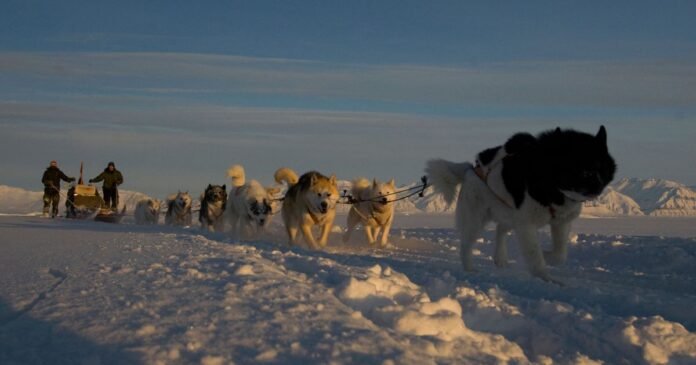

In Greenland’s harsh icy expanse, a highly trained special forces team maneuvers swiftly by dog sled, armed to the teeth, embodying elite survival skills. Denmark’s renowned Sirius Dog Sled Patrol operates in an unforgiving environment where a single misstep can spell doom, enduring hunger, frostbite, and months of solitude to become masters of one of the world’s most extreme terrains. Tasked with long-range reconnaissance missions in the frozen north, where perpetual darkness and bone-chilling temperatures as low as -55C reign, these teams brave the elements for up to five months at a stretch.
Recent rumblings suggest a potential clash between the US military and this specialized Royal Danish Navy unit, as President Donald Trump considers seizing the mineral-rich Arctic territory of Greenland. However, the Sirius Dog Sled Patrol is far from a conventional military force, with a storied lineage dating back to World War Two, when its forerunners thwarted Nazi advances along Greenland’s isolated shores. Despite Trump’s mockery of Denmark’s Arctic defenses, particularly deriding the addition of an extra dog sled patrol, Danish defense experts rebuff his claims as dangerously uninformed.
The Arctic’s melting ice has turned Greenland into a coveted hub for global powers eyeing untapped resources, leading Denmark to announce a substantial £4.8 billion military reinforcement to safeguard the autonomous territory. Amid rising tensions, the Sirius Patrol stands as the first line of defense in Greenland’s frigid north, utilizing dog sleds to patrol terrains inaccessible to modern military vehicles. Named after the Dog Star, Sirius, this unique unit stands alone as the world’s sole dog sled special forces, patrolling where no others can tread.
Comprising six sled teams, each manned by two naval soldiers, the Sirius Patrol embarks on missions covering an area equivalent to Britain and France combined each autumn. Enduring arduous missions lasting up to five months, these soldiers face mental and physical trials amidst near-total isolation, forging unbreakable bonds with their Greenland huskies trained for resilience in the unforgiving environment. The huskies serve as both transport and early warning systems, alerting soldiers with a distinct growl at the approach of polar bears.
In these desolate Arctic expanses, survival hinges on canned rations, scarce showers, infrequent clothing changes, and minimal contact with the outside world. Selection for the Sirius Patrol is notoriously rigorous, demanding recruits to undergo extreme physical and psychological tests to ensure resilience in prolonged solitude. The unit’s inception traces back to 1941 as the North-East Greenland Sledge Patrol, established to gather crucial meteorological data during World War Two amid escalating Nazi interest in Greenland’s strategic significance.
Transitioning into the Cold War era, the patrol reemerged in 1950 as the Sirius Dog Sled Patrol, evolving into a vital defense mechanism against Russian and Chinese interests in the region. In an age dominated by advanced surveillance technologies, Sirius persists as a testament to on-the-ground defense strategies, deterring potential threats through unwavering presence and specialized expertise. The invaluable skills honed by the Sirius Patrol in navigating Greenland’s treacherous terrain render them an indispensable asset in safeguarding the region’s interests.