
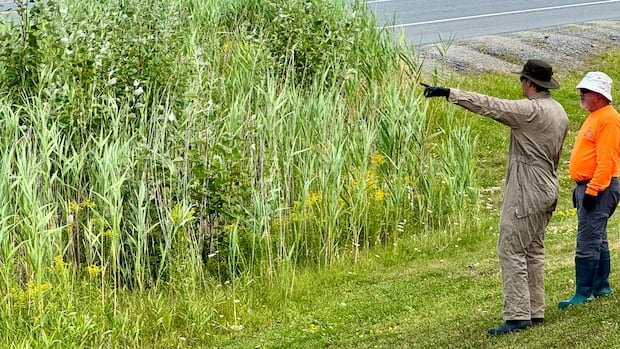

An invasive plant is spreading further into northern Ontario, prompting communities to take action to identify and manage it before it establishes itself. The Junction Creek Stewardship Committee, based in Sudbury, organized a workshop in collaboration with the Invasive Phragmites Control Centre to educate individuals on recognizing invasive phragmites and preventing its proliferation.
Invasive phragmites, also known as common reed, can form dense stands that outcompete native vegetation and disturb wetland ecosystems. Jayden McGleish, a field supervisor at the Invasive Phragmites Control Centre, highlighted the plant’s encroachment into northern Ontario, including significant patches emerging in Sudbury.
The invasive plant poses a threat to native species like cattails and bulrushes, hindering wildlife movement in affected areas. McGleish expressed concern over the challenges faced by turtles and frogs navigating through dense phragmites patches, noting instances where wildlife struggled or perished. Moreover, the plant’s growth along roads and through asphalt can lead to drainage issues and road damage, incurring costs for municipalities.
Although invasive phragmites is more prevalent in southern Ontario, its presence in northern communities such as Sudbury, Sault Ste. Marie, Timmins, and Thunder Bay is increasing. Erik Barr, a contract worker at Conservation Sudbury, emphasized the importance of proactive measures in containing the invasive plant’s spread in Sudbury.
Distinguishing between invasive and native phragmites is crucial in monitoring and managing the plant. Barr outlined key differences such as wider leaves and thicker stems in the invasive variety, contrasting with the reddish hue on stems of native phragmites. He also highlighted distinct features at the junction of leaves and stems to aid in identification.
Educating the public on identifying invasive phragmites is essential for tracking its presence, especially along transportation routes like roads and railways where accidental spread can occur. Jaclyn Groom from the Junction Creek Stewardship Committee shed light on how the plant thrives in metal-rich soils near mine sites and tailings areas, with concerns about its spread from Copper Cliff Creek into Junction Creek.
To address invasive phragmites, Chuck Simpson from the Invasive Phragmites Control Centre emphasized the use of backpack sprayers and the herbicide Timberline for effective treatment. Despite the severity of the situation, Simpson noted that Sudbury’s abundance of native phragmites offers some respite, and treatments can yield high kill rates with proper application.
The workshop included a demonstration of treatment methods, showcasing the efficacy of backpack sprayers and herbicide in managing invasive phragmites. Simpson mentioned the potential for plant regrowth but expressed optimism about the treatment’s success in curbing the plant’s proliferation.