
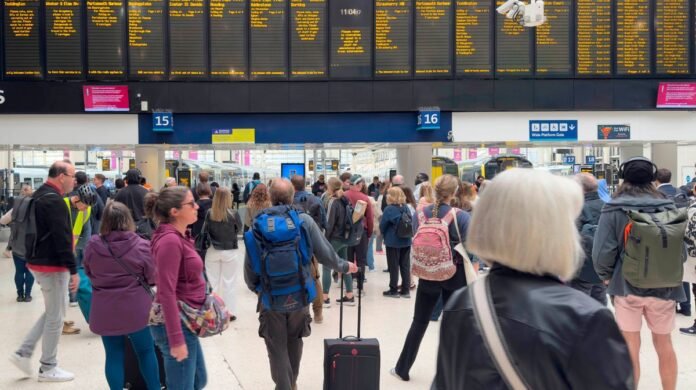

Passengers are encountering significant disturbances at a major railway hub in the UK due to reports of smoke on the tracks coinciding with unusually high temperatures. South Western Railway (SWR) has announced that some London Waterloo services are operating at reduced speeds as a precautionary measure while safety checks are conducted. The railway company informed travelers of smoke sightings along the track section between London Waterloo and Vauxhall, leading to delays on routes to and from London Waterloo, including destinations like Guildford, Woking, Chessington South, Dorking, Hampton Court, Shepperton, and Strawberry Hill.
Although SWR did not confirm a direct link to the ongoing hot weather conditions, temperatures remained above 21.3C on Monday at Kenley Airfield in south London, marking the hottest May day on record according to the Met Office. Furthermore, Kew Gardens in south-west London saw a provisional all-time high spring temperature of 34.8C on the same day. The Met Office identified 12 locations across the UK where temperature records were surpassed, with 97 monitoring sites registering 30C or above.
While the rail lines between Waterloo and Vauxhall have now reopened, residual disruptions are anticipated until 11 am. SWR stated, “Train services to and from these stations may encounter delays or schedule changes. Normal service resumption is expected by 11:00 on 26/05.” Regarding suburban services, SWR advised that journeys to and from London Waterloo and surrounding areas could still face delays until operations stabilize.
Passengers are urged to allow extra time for their travels as services gradually return to their usual schedules. SWR advised checking live journey updates for the latest information since some services may still be in recovery mode. Travelers heading to and from London Waterloo are advised to factor in additional time as the train services normalize. SWR also encouraged passengers to seek assistance from staff or use station help points if needed, apologizing for any inconvenience caused during their journeys.