
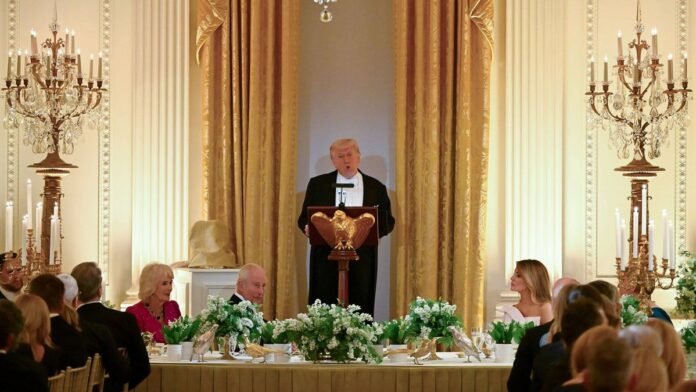

President Donald Trump faced backlash for breaking etiquette during King Charles and Queen Camilla’s official visit to the United States after making a contentious comment at a formal dinner.
The King is currently touring the US in anticipation of the country’s upcoming 250th anniversary celebrations, amidst ongoing speculation about the strength of the longstanding “special relationship” between the UK and US.
During a recent state dinner, both Trump and the King delivered speeches. Trump’s statement insinuated that the monarch supported his stance on Iran, stating, “We have effectively defeated that specific adversary militarily, and we will never allow them – Charles supports me even more than I do – to possess nuclear weapons.”
This remark drew criticism as some believed it jeopardized the King’s anticipated political neutrality, leading Buckingham Palace to issue a response. A source close to the royal family expressed astonishment, mentioning, “He went off-script. I was shocked by his words… It was inappropriate to put the King in such a position.”
A Palace spokesperson later emphasized, “The King is keenly aware of his Government’s consistent stand on preventing nuclear proliferation.”
The incident has raised concerns about its potential impact on the success of the state visit and the King’s involvement in Middle Eastern geopolitical tensions, as reported by the Express.
BBC diplomatic correspondent James Landale downplayed the incident’s lasting effects, suggesting that if the King did express agreement, it may align with the established position of his government in preventing Iran from acquiring nuclear arms through diplomatic means, rather than endorsing military conflict.
Against the backdrop of Trump’s criticisms of allies like the UK for not participating in US military actions against Iran, tensions have heightened. The closure of the Strait of Hormuz due to this conflict has further complicated the situation.
Former Middle East adviser Brett McGurk, speaking after the King’s well-received address, acknowledged Britain’s significant soft power but highlighted its limited hard power, particularly in military capabilities. He proposed that addressing this limitation could enhance relations with Washington by fostering shared interests and burden-sharing, especially in critical regions like the Strait of Hormuz.
At Reach and our affiliated entities, we and our partners utilize data from cookies and other identifiers on your device to enhance your website experience, analyze usage patterns, and display personalized advertisements. You have the option to opt-out of data sharing or selling by clicking the “Do Not Sell or Share my Data” button at the bottom of the webpage. Please be aware that preferences are specific to each browser. By using our website and services, you agree to the use of cookies and consent to the practices outlined in our Privacy Notice and Terms and Conditions.