
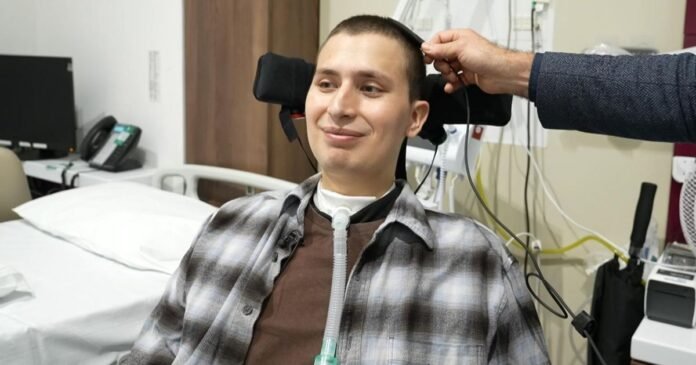

A student from the UK, Sebastian Gomez-Pena, shared his awe-inspiring experience after having a brain implant designed by Elon Musk’s company, Neuralink. Sebastian had faced paralysis from a severe accident in Venezuela, leaving him with significant challenges. However, after becoming one of the pioneering individuals in the UK to undergo the Neuralink brain implant procedure, Sebastian can now control a computer screen solely through his brain signals. This innovative technology, which utilizes AI to interpret brain activity, has opened up new possibilities for Sebastian, allowing him to engage in activities like browsing the internet and playing chess once again.
The implantation process involved the use of a coin-sized chip implanted at University College London Hospital. During the intricate procedure, a specialized robot inserted over a thousand microscopic electrodes into Sebastian’s motor cortex, enabling the transmission of brain signals wirelessly to a computer for interpretation. Mr. Harith Akram, a neurosurgeon involved in the trial, expressed amazement at the level of control Sebastian now possesses, emphasizing the significant impact this technology could have on individuals with severe neurological disabilities.
Elon Musk’s vision for Neuralink extends to enabling users to control robotic limbs through brain signals. The technology has already been implemented in several individuals across different countries, targeting those with conditions like spinal injuries or ALS. While the current trial outcomes have not yet been formally published, Neuralink aims to further enhance the technology to encompass speech restoration, vision improvement, and interfacing with robotic prosthetics. Musk’s company stresses the importance of conducting additional large-scale trials to ensure the long-term safety and reliability of the device before it can be widely used for medical purposes.