
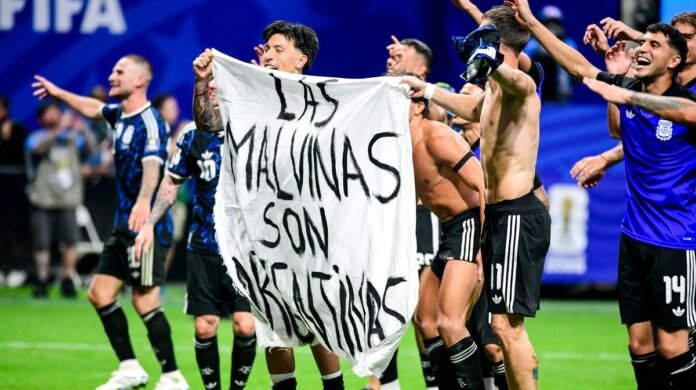

Falklands War veterans and political figures express their collective outrage at soccer players who unfurled a banner proclaiming “the Falklands are Argentinian” following Argentina’s contentious victory over England in the World Cup semi-final.
Among the individuals involved in showcasing the sign, which bore the Spanish phrase “Las Malvinas son Argentinas,” were Premier League stars Lisandro Martinez from Manchester United, Cristian Romero from Tottenham Hotspur, and former Manchester City player Julian Alvarez. Though originally brought into the Atlanta stadium by fans, the banner eventually found its way onto the field after the match concluded.
The game commenced amidst a tense atmosphere, with both national anthems receiving loud boos from the audience. Following the match, Argentina’s Vice President Victoria Villarruel shared a celebratory message emphasizing the significance of the victory, accompanied by a video featuring what seemed to be Argentinian military personnel.
Prior to the match, Villarruel referred to England as “invaders” and “usurping pirates.” In Buenos Aires, fans carried a coffin shaped like the Union Flag, while other supporters burned an effigy of the St. George’s Cross.
Speaking out against the incident, Falklands War veteran Simon Weston, who suffered severe burns during the conflict, criticized the players’ actions, attributing their behavior to propaganda from Argentine politicians. Weston emphasized the importance of respecting the Falkland Islanders’ right to self-determination and urged Argentine authorities to exercise statesmanship rather than inciting animosity.
Jarvis Burt, whose brother perished in the Falklands War, echoed Weston’s sentiments, highlighting the need for the players to demonstrate respect for the lives lost in the conflict. He condemned the display of the banner as inappropriate and urged FIFA to take strict action against the individuals involved.
Liberal Democrat leader Ed Davey called for the barring of the players from the World Cup final, citing their breach of regulations prohibiting the display of political messages. The potential violation of Article 34.3 of the tournament rules, which forbids political messaging by players, could lead to disciplinary measures against the players.
Addressing the issue, Prime Minister Keir Starmer’s spokesperson reaffirmed the UK’s stance on the Falklands, emphasizing the islanders’ right to self-determination. The matter was deemed within FIFA’s purview, with the spokesperson advocating for an investigation into the incident.
The ongoing political tensions between Argentina and Britain over the Falklands were reignited by the banner incident, with the Falkland Island Legislative Assembly condemning the insensitivity of the display. The Assembly stressed the traumatic impact of the conflict on their people, underscoring the need for sensitivity and respect in such matters.
In light of the controversy, the Argentine players’ actions may face scrutiny for breaching FIFA regulations, reflecting the broader geopolitical complexities surrounding the Falklands issue.