
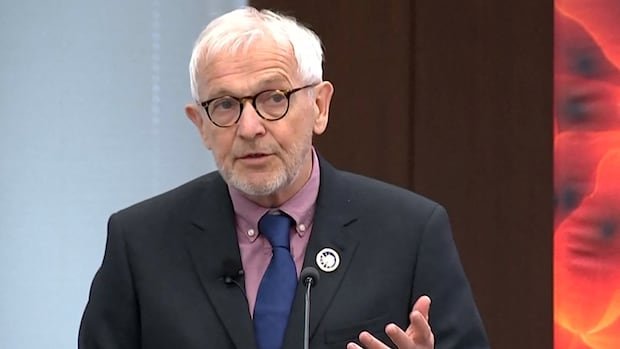

Belgian American physicist Francis Halzen, aged 82, was awarded the 2026 Nobel Prize in Physics in Stockholm on Tuesday. The Nobel committee recognized his significant contributions to the IceCube Neutrino Observatory and the discovery of high-energy neutrinos of celestial origin. Situated at the Amundsen–Scott South Pole Station in Antarctica, the observatory utilizes ice at the South Pole to detect neutrinos, which are elusive particles capable of traversing matter without leaving a trace.
Eva Olsson from the Royal Swedish Academy of Sciences described neutrinos as messengers from the cosmos, shedding light on distant galaxies and stellar phenomena. Halzen, affiliated with the University of Wisconsin–Madison, expressed his surprise and delight upon receiving the prestigious award while attending a conference in Italy.
Neutrinos, dubbed “ghost particles,” are omnipresent cosmic entities with minuscule mass, emanating from celestial bodies like the sun. Halzen’s research on neutrinos offers insights into the evolution of the universe, facilitated by the IceCube Observatory’s innovative technology.
The IceCube, covering a cubic kilometer of space, began operations in 2011, marking a culmination of a project envisioned in the late 1980s. Plans for an extension, IceCube-Gen2, spanning eight cubic kilometers of ice, aim to enhance neutrino detection capabilities by tenfold by 2033.
Prime Minister Bart De Wever commended Halzen for his lifelong dedication to unraveling cosmic mysteries through neutrino research. The Nobel Prize in Physics acknowledges groundbreaking scientific achievements, with past laureates like Dr. Arthur McDonald of Canada also honored for their contributions to the field.
The Nobel Prize, established by Alfred Nobel, is awarded annually to individuals who have made significant contributions to humanity. Nobel’s legacy, rooted in scientific innovation and cultural pursuits, continues to honor exceptional individuals in various fields. The laureates will be presented with their awards on December 10, commemorating Nobel’s legacy.