
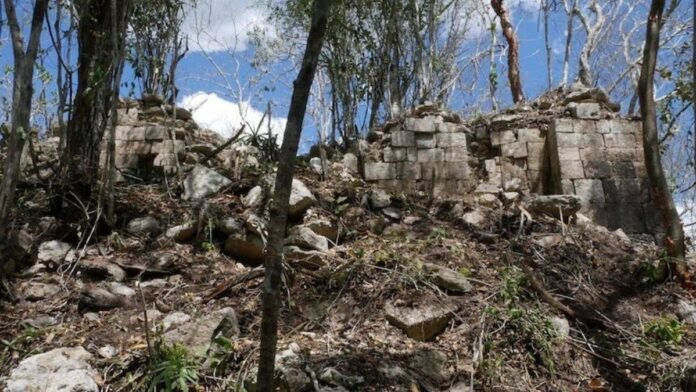

A group of adventurers has discovered an ancient Mayan city hidden in the Mexican jungle for over 1,000 years. The team, consisting of explorers from Slovenia and Mexico, made this remarkable find while researching in the Calakmul Nature Reserve in Mexico. The city, now named Minanbe, was uncovered by the researchers as they ventured through the dense vegetation in the state of Campeche.
Spanning across 13 hectares, the city is believed to have been constructed between 600 and 900 AD. The expedition was led by archaeologist Ivan Sprajc, associated with the Research Centre of the Slovenian Academy of Arts and Sciences. The discovery was made following an analysis of LiDAR imagery by archaeologists Atasta Flores Esquivel, Vitan Vujanović, Israel Chato López, and Quintín Hernández Gómez.
The city features various structures, including a 13-meter-tall pyramid in the Rio Bec style and a relief showing water elements and a beheading. Vujanović noted it was the first time he had documented a well-preserved temple and a stele with glyphs. The project, focused on exploring the Central Maya Lowlands, was supported by the Archaeology Council of the National Institute of Anthropology and History.
To navigate the challenging forest terrain, the explorers relied on machetes and quad bikes. Sprajc mentioned that the absence of clear paths indicated the significance of their discovery. Minanbe, as named by the team, reflects the tradition in Maya archaeology of naming sites based on their characteristics or the circumstances of discovery.
Sprajc observed that Minanbe aligns with patterns seen in other regional discoveries, suggesting an agriculturally-based power structure. However, questions remain about potential external influences on the city’s social dynamics.