
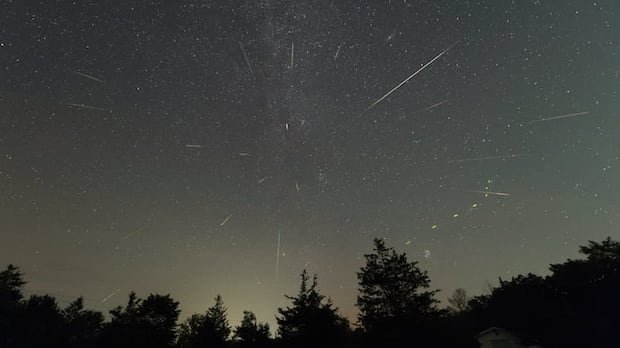

Torontonians may have the opportunity to witness a meteor shower and a partial solar eclipse on Wednesday, pending favorable weather conditions. The Perseid meteor shower is anticipated to peak over Ontario on Wednesday evening through Thursday morning, known for producing stunning fireballs with long streaks of light. NASA forecasts approximately 50 to 100 meteors visible per hour during this annual event.
Prior to the meteor shower, a partial solar eclipse, where the moon partially covers the sun, will be observable in Toronto on Wednesday afternoon from 12:56 p.m. to 2:24 p.m., according to Sky and Telescope. However, weather forecasts suggest a chance of showers and thunderstorms in the afternoon and evening, potentially hindering visibility for both events, as reported by Environment Canada.
The national weather agency also mentions the possibility of fog patches developing closer to midnight, dissipating by Thursday morning. Should the meteor shower not be visible on Wednesday, there is still a chance to catch it on Thursday night, according to Peter Brown, Canada Research Chair in Meteor Astronomy and a professor at Western University. The Perseid meteor shower, commencing on July 17, is expected to conclude on August 24, based on NASA’s timeline.
To maximize the chances of spotting the Perseids, experts recommend finding a dark location away from city lights. The best viewing time is between midnight and dawn, although some meteors may be visible as early as 10 p.m. Individuals within urban areas can still observe a few meteors per hour from a dark park, provided the weather cooperates. Peter Brown highlights the importance of darkness for optimal meteor viewing due to their faint nature.
The presence of a new moon on Wednesday will enhance the viewing experience this year, creating darker skies for better visibility of the meteor shower, as noted by Pauline Barmby, an astronomy professor at Western University. The meteor shower appears to originate from the Perseus constellation, deriving its name from this phenomenon, despite the debris originating from the 109P/Swift-Tuttle comet, which circles the sun every 133 years. NASA indicates that Earth will not encounter the comet again until 2125.
During the partial solar eclipse in Ontario, approximately eight percent of the sun will be obscured on Wednesday afternoon. Utilizing solar viewing glasses may enable observers to witness a temporary partial eclipse. A total solar eclipse will occur further east, over Greenland and Iceland, where the sun will be completely obscured for a brief period.